
Marshall County Federal Release Scope
The federal route can begin locally without ending locally. The U.S. Marshals Service controls many federal pretrial prisoners and may place them in federal, state, local, or private facilities. The Bureau of Prisons generally controls people serving federal prison sentences. A federal judge may order release in a pending case, while the BOP may later report release from a sentence. These are separate custodians and events.
No federal prison was identified inside Marshall County through the official source sweep. That researched absence does not mean a federal defendant could never be housed for a time at a local or contract jail. It means that a page labeled as a Marshall County federal “facility” would be inaccurate. The correct subject is the federal systems serving cases and transfers that touch the county.
| Situation | First official source | What to verify |
|---|---|---|
| Federal sentenced prisoner | BOP Inmate Locator | Location, release date, released status |
| Federal pretrial prisoner | PACER or District of Minnesota court | Release, detention, or transfer order |
| USMS custody movement | USMS records request | Custody, transport, transfer, or release event |
| Departure from county jail | Marshall County Sheriff record | Transfer time, basis, and federal recipient |
Search Marshall Federal Release Records
The BOP Inmate Locator is the public search for people held or released by the Bureau of Prisons. Search by BOP Register Number, DCDC number, FBI number, or INS number when one is known. A name search can use first, middle, and last name plus race, sex, and age filters. Numeric identifiers reduce the chance of confusing two people with similar names.
- Open the BOP locator and choose the number or name search. Use the full register number when available.
- Match the result through name, register number, age, race, and sex. Do not rely on name alone.
- Read the Location and Release Date fields together. A past release date with no facility location means the person is no longer in BOP custody.
- Treat “RELEASED” as the end of BOP custody only. It does not end court supervision or custody held by another agency.
- If the case appears pretrial or the record says “IN TRANSIT,” check the federal court and USMS route before deciding what happened.
The official federal locator form shows both identifier and name searches:
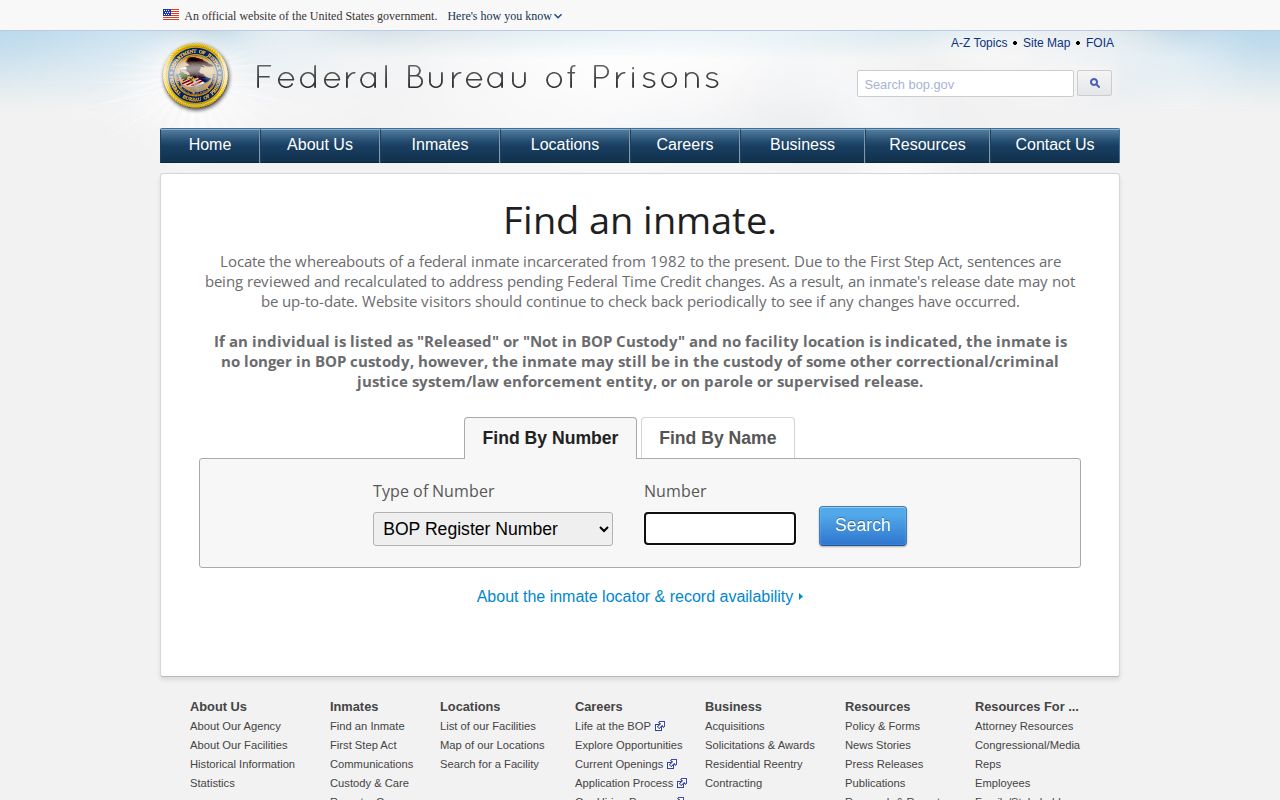
The form is federal-only. It does not search Marshall County Jail, Minnesota DOC, ICE, or an ordinary state court case.
Marshall Federal Released Status
BOP generally covers federal inmates released after 1982. A result may contain the person's name, register number, age, race, sex, Release Date, and Location. A past date with no institution location supports the statement that the person left BOP custody on the shown date. The word “RELEASED” has the same limited effect. It does not prove freedom from federal supervised release, parole, an ICE hold, state custody, or another legal restraint.
BOP also warns about agency boundaries. Someone removed from BOP custody by the U.S. Marshals can later be released by a court without more BOP notice. That makes the federal docket essential in pretrial and transport settings. A person may also have a BOP release date but remain subject to a federal judge's supervision terms. The locator is a custody source, not a complete account of the case.
The BOP explanation of released records describes its release-date and location wording:
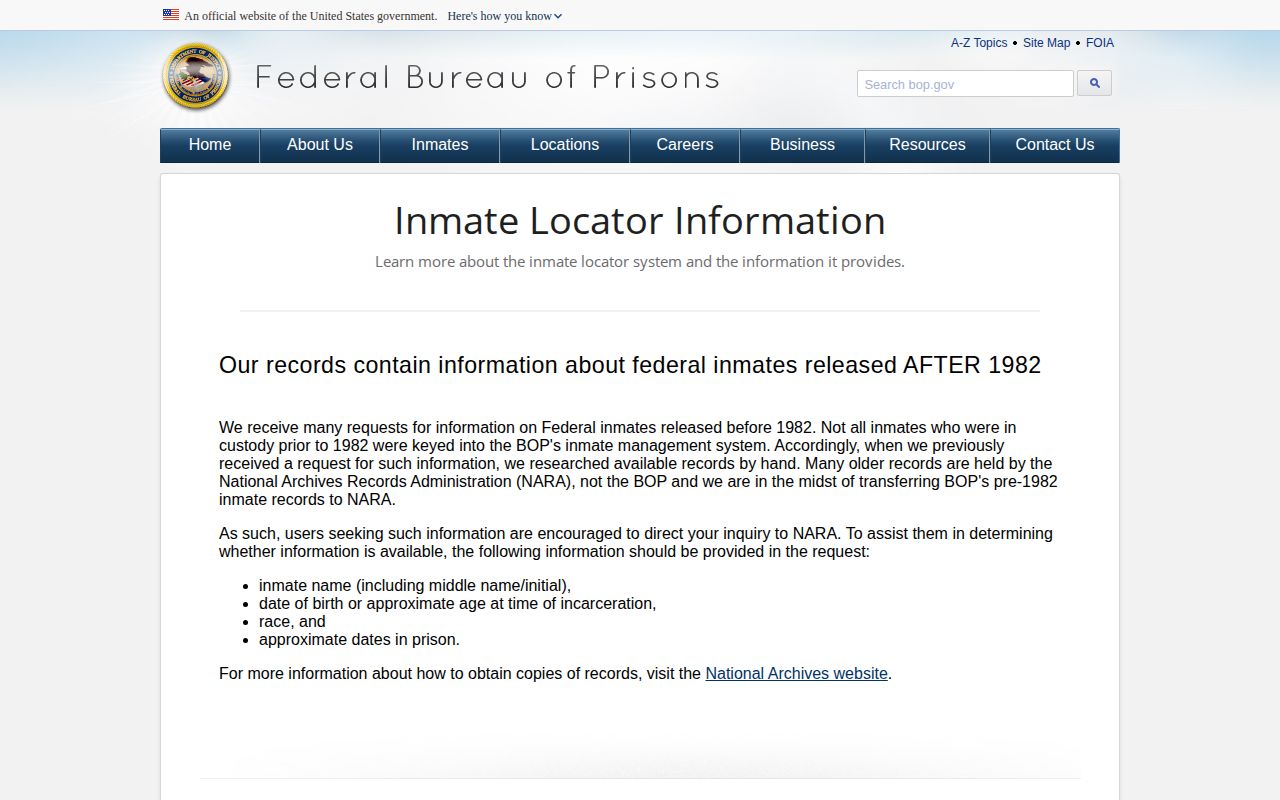
That explanation supplies the correct meaning of the fields and the limits that should accompany any federal release conclusion.
- BOP custody
- Federal prison authority administered by the Bureau of Prisons.
- USMS custody
- Federal detention and transport authority often used before trial or during movement.
- Supervised release
- Court-ordered federal supervision in the community after imprisonment.
- Release date
- The date BOP says its custody ended, not proof that every legal restraint ended.
Note: Save the BOP register number with the release date because the identifier helps distinguish similar names across federal records.
Marshall U.S. Marshals Release Path
The U.S. Marshals Service has no public historical locator equivalent to BOP's search. It manages many people charged in federal court before trial and moves prisoners among authorized sites. A federal pretrial prisoner may be placed at a local, state, federal, or private facility. The building alone does not tell which agency owns the detention decision.
Use PACER or the U.S. District Court for the District of Minnesota to find a public detention, release, sentencing, or commitment order. The docket gives the legal action. It may show that a judge released the person before trial, detained the person, or committed the person after sentencing. It does not necessarily give the exact physical time of movement.
For the agency event, use USMS FOIA or the USM-184 request form. Identify the person, approximate dates, federal district and case number, and the exact custody, transport, transfer, or release record sought. A focused request helps separate release from a move to BOP, another jail, or another custodian.
Note: A federal court case can remain open after pretrial release, so case status alone does not prove present custody.
Marshall County Federal Transfers
A person can leave Marshall County Jail under federal authority. In that event, request the sheriff's transfer data under Minnesota Statutes section 13.82, subdivision 2(h): transfer date and time, legal basis, and receiving agency or person. The entry proves the end of that county-jail custody segment. It does not prove later release by USMS or BOP.
Continue with the named federal recipient. If BOP received the person after sentence, search the locator and match the register number. If USMS controlled a pretrial placement, read the District of Minnesota docket and seek agency records. If the sheriff record instead names ICE, use the immigration custody path because the BOP locator does not cover ICE detention.
This chain prevents a common error. “Left the jail” and “released by federal authorities” can occur weeks, months, or years apart, or the second event may not yet have occurred. Each statement needs its own agency record and date. The Marshall County released inmates search path covers the county event before the federal handoff.
The legal basis should also stay tied to the right court. Marshall County District Court addresses Minnesota cases. The U.S. District Court for Minnesota addresses federal detention, release, plea, sentence, and supervision orders within its jurisdiction. A state docket cannot prove a federal judge's action, just as a federal order cannot supply the sheriff's physical transfer time. Matching case numbers, dates, and identifiers preserves that boundary.
Older Marshall Federal Release Records
BOP's ordinary locator generally covers federal releases after 1982. For an older prison record, follow BOP's National Archives guidance. Useful identity details include full name, date of birth or approximate age, race, and approximate incarceration dates. A federal case number, register number, and known institution can narrow the search.
USMS history follows a different path. Seek the public federal docket for court authority and use agency records procedures for custody and transport. State court systems and the Minnesota DOC Viewer cannot stand in for these federal sources. If a county record shows only a federal transfer with no specific BOP admission, do not assume the person served a BOP prison term.
Federal release record routes
Bureau of Prisons: Inmate Locator and About Our Records
U.S. Marshals Service: FOIA and USM-184 request
Federal court: PACER and U.S. District Court, District of Minnesota
A records request should seek an event, not a conclusion. For BOP, identify the register number and approximate custody or release period. For USMS, identify the federal district, court file, placement or transport dates, and requested transfer or release record. For the court, seek the filed detention or release order. These focused requests create a traceable chain without asking one office to speak for another federal custodian.
Note: Pre-1982 federal prison history follows the BOP National Archives route rather than the ordinary post-1982 locator coverage.
Separate Marshall Custody Systems
Marshall County Jail, Minnesota DOC, BOP, USMS, and ICE are not interchangeable databases. The county roster concerns a present local snapshot. Minnesota DOC concerns state commitments and people still under state jurisdiction. BOP concerns federal prison custody. USMS concerns federal detention and movement, often before trial. ICE concerns immigration custody.
A complete inquiry may cross two or more systems, but it should do so in order. Start with the last confirmed custodian. Obtain a transfer recipient when the person moved. Then search or request the receiving agency's record. This method preserves both the event and its timeline without treating one agency's release as release from all authority.
For example, a sheriff record can show that USMS received a person. The federal docket can show a later detention or release order. A BOP result may then be absent because the person never entered a BOP sentence, or it may later show prison custody after commitment. Each outcome is plausible within the researched system map. Only the matched records establish which one occurred in the named Marshall County matter.